Government & Defense SCORM Guide: Section 508, DoD DISA STIGs & Sovereign E-Learning Compliance
The complete architectural procurement guide for civil service directors, defense contractors, and public sector LMS administrators on converting sensitive policy PDFs into Section 508, WCAG 2.1 AA, and DoD SCORM 2004 4th Edition certified modules with zero cloud data retention.
- 01.1. The Public Sector Training Dilemma: Moving Past Static PDF Directives
- 02.2. Section 508 & WCAG 2.1 AA Accessibility Mandate
- 03.3. DoD ADL SCORM 2004 4th Edition vs. SCORM 1.2: The 4KB Suspend Data Barrier
- 04.4. Sovereign Data Architecture: Zero Cloud Data Retention
- 05.5. Regional Sovereign Procurement Frameworks: US, UK, Australia, New Zealand & Singapore
- 06.6. The 60-Second SOP to SCORM 2004 Workflow
- 07.Frequently Asked Questions
Direct Answer: Federal mandates (Section 508, WCAG 2.1 AA, EN 301 549) require all government e-learning to support screen readers, keyboard focus trapping, and high contrast out-of-the-box.
- Federal mandates (Section 508, WCAG 2.1 AA, EN 301 549) require all government e-learning to support screen readers, keyboard focus trapping, and high contrast out-of-the-box.
- SCORM 1.2 packages crash in modern government LMSs due to the 4,096-character suspend_data limit; upgrading to ADL SCORM 2004 4th Edition expands bookmarking capacity to 64,000 characters.
- Classified, ITAR, and CUI training materials cannot be uploaded to commercial SaaS clouds. DocScorm zero-storage in-browser WebAssembly compiler guarantees absolute data sovereignty.
- Standardized playbooks align with US DoD, UK G-Cloud, Australia ASD Essential Eight, New Zealand NZISM, and Singapore GovTech IM8 directives.
1. The Public Sector Training Dilemma: Moving Past Static PDF Directives
Across civilian government agencies, municipal emergency services, and defense command commands, standard operating procedures (SOPs) and policy memos have historically been distributed as dense, unverified PDFs. Employees scroll through a 50-page ethics or cyber-hygiene circular, click a generic acknowledgement checkbox, and resume their duties.
When internal Inspectors General (OIG), federal auditors, or defense security assessors review compliance records, static PDF acknowledgements fail to establish verifiable competence or interactive seat-time. Public sector organizations are now mandated to convert text directives into interactive, trackable SCORM courseware with verifiable CMI interaction timers and objective mastery tracking.
2. Section 508 & WCAG 2.1 AA Accessibility Mandate
Under Section 508 of the US Rehabilitation Act, the UK Public Sector Bodies Accessibility Regulations 2018, the European Accessibility Act (EN 301 549), and the New Zealand Accessibility Charter, all government training materials must be fully accessible to individuals with visual, auditory, motor, and cognitive disabilities.
Legacy authoring tools produce complex Flash or nested canvas DOM trees that hide content from assistive screen readers like JAWS, NVDA, and Apple VoiceOver. DocScorm compiles courses with semantic HTML5 landmark tags (header, main, nav), high contrast typography (exceeding 4.5:1), keyboard focus trapping, and automated screen-reader aria-labels for every interactive assessment.
3. DoD ADL SCORM 2004 4th Edition vs. SCORM 1.2: The 4KB Suspend Data Barrier
The US Department of Defense Advanced Distributed Learning (ADL) initiative created SCORM 2004 specifically to overcome the architectural flaws of SCORM 1.2. The most catastrophic failure in legacy SCORM 1.2 is the 4,096-character ceiling on cmi.core.suspend_data.
When public sector personnel take comprehensive 40-module training courses or complex branching disaster-response simulations, the LMS bookmarking string truncates once it exceeds 4KB. Upon logging back in, the LMS resets the user to Module 1 or throws a runtime error. ADL SCORM 2004 4th Edition expands bookmarking storage by 1,500% to 64,000 characters, preventing learner progress loss across Canvas, Totara, and Moodle Workplace.
4. Sovereign Data Architecture: Zero Cloud Data Retention
Defense contractors handling Controlled Unclassified Information (CUI), International Traffic in Arms Regulations (ITAR) data, or police tactical SOPs cannot legally upload files to third-party public cloud services where data may be logged, cached, or processed by unauthorized AI models.
DocScorm operates on a revolutionary zero-storage client execution architecture. All text parsing, cognitive chunking, question synthesis, and SCORM packaging execute directly inside your browser memory using local WebAssembly. Zero bytes of your training documentation or employee records are transmitted to or stored on external cloud servers, satisfying air-gapped security protocols.
5. Regional Sovereign Procurement Frameworks: US, UK, Australia, New Zealand & Singapore
Procurement teams evaluate training software against national cyber baselines. DocScorm packages are pre-engineered to satisfy regional standards without bespoke engineering overhead:
- United States: NIST SP 800-53, CMMC Level 2, DoD DISA STIG compliance, and Section 508 VPAT certification.
- United Kingdom: Crown Commercial Service G-Cloud frameworks, EN 301 549, and Public Sector Regulations 2018.
- Australia (Canberra/Sydney/Melbourne): APS Digital Service Standard, Defence Security Principles Framework (DSPF), and ASD Essential Eight air-gapped guidelines.
- New Zealand (Wellington/Auckland): New Zealand Information Security Manual (NZISM), Protective Security Requirements (PSR), and Te Tiriti cultural framing.
- Singapore (GovTech/Marina Bay): Instruction Manual 8 (IM8) IT Security Policy and SkillsFuture Singapore (SSG) WSQ e-learning standards.
6. The 60-Second SOP to SCORM 2004 Workflow
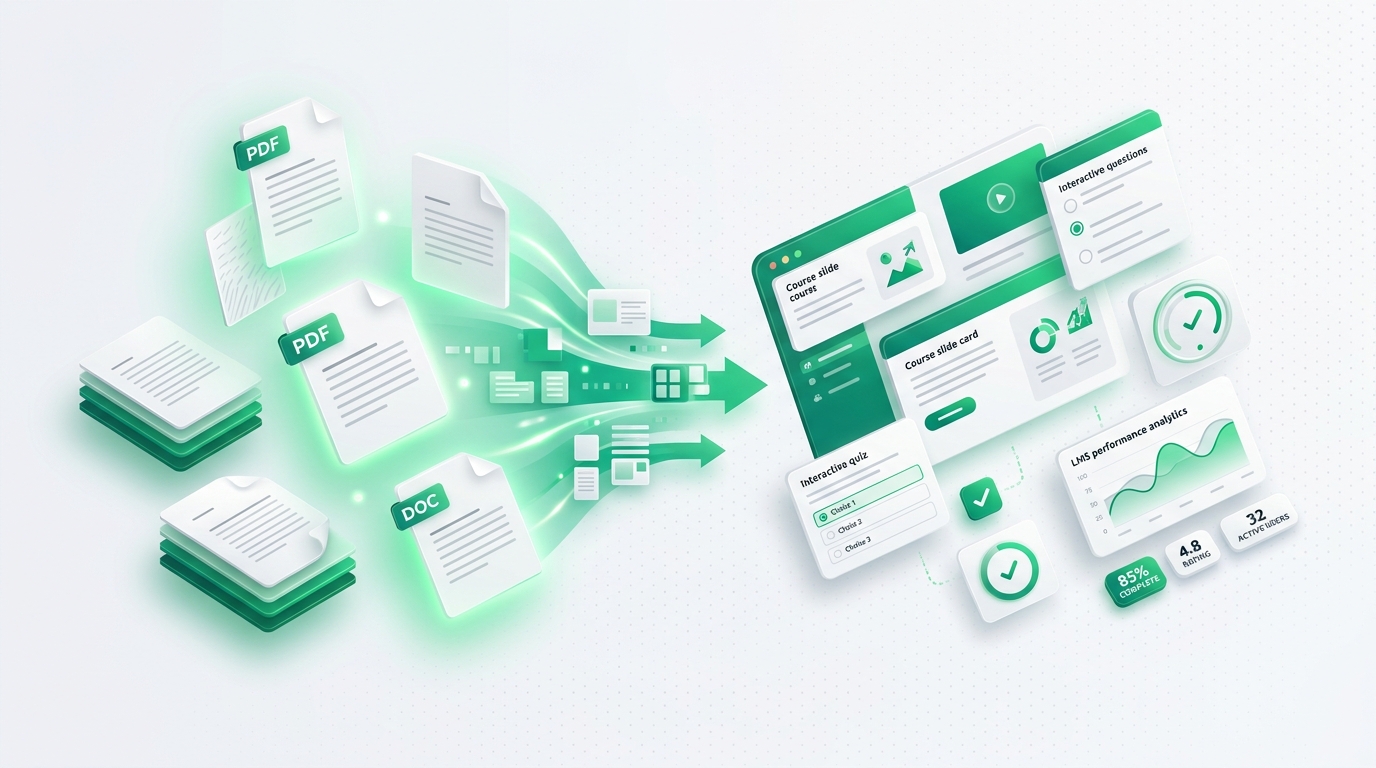
With DocScorm, public sector agencies do not need costly 6-month instructional design agency retainers or high-maintenance Articulate 360 seat licenses. Simply drop any Word policy (.docx) or PDF circular into DocScorm Studio, configure mandatory seat-time interlocks and situational dilemma questions, and export an ADL SCORM 2004 4th Edition package in 60 seconds.
Connect your instructional workflows directly to DocScorm's course creation tools and validators:
Convert PDFs (Up to 200 Pages), DOCX, PPTX, or MP4 Videos into SCORM in 60s
Open DocScorm Studio or explore the Pro Plan (50 monthly credits + 1-click multi-language bundles + embedded course-source.json round-trip editing).
Frequently Asked Questions
Can DocScorm be deployed in air-gapped or classified government networks?
Yes. Because the DocScorm compilation engine runs 100% in-browser using WebAssembly and client-side JavaScript, it requires zero external API communication during package generation, making it fully compatible with secure and isolated intranets.
Does DocScorm support Section 508 VPAT documentation?
Yes. DocScorm provides an official Voluntary Product Accessibility Template (VPAT) documenting conformance with Section 508 and WCAG 2.1 Level AA criteria for federal and state procurement officers.
Can we batch migrate our entire university or agency course catalog from SCORM 1.2 to 2004?
Yes. The DocScorm Institutional Batch Migration tool and CLI script allow organizations to upload 50+ legacy packages simultaneously, inject modern runtime bridges, upgrade suspend_data to 64KB, and download a consolidated master archive with an executive audit CSV report.