European Universities E-Learning Playbook: Transforming Course Packs into Multilingual, EAA & GDPR-Compliant SCORM Packages
How European universities across Oxford, Cambridge, Zurich, Paris, and Munich convert ECTS course packs into European Accessibility Act (EAA 2025) compliant, multilingual SCORM 1.2/2004 modules with total GDPR academic sovereignty.
- 01.The European Accessibility Act (EAA 2025) & Academic LMS Compliance
- 02.Bologna Process & ECTS Modularization: Structuring Dense Academic Syllabi
- 03.Delivering Multilingual Courses Across Cross-Border European Consortia
- 04.Academic Data Sovereignty: Why GDPR Forbids Feeding University IP into Consumer AI
- 05.Deploying to Pan-European LMSs: Moodle, Canvas, ILIAS, and itslearning
- 06.Frequently Asked Questions
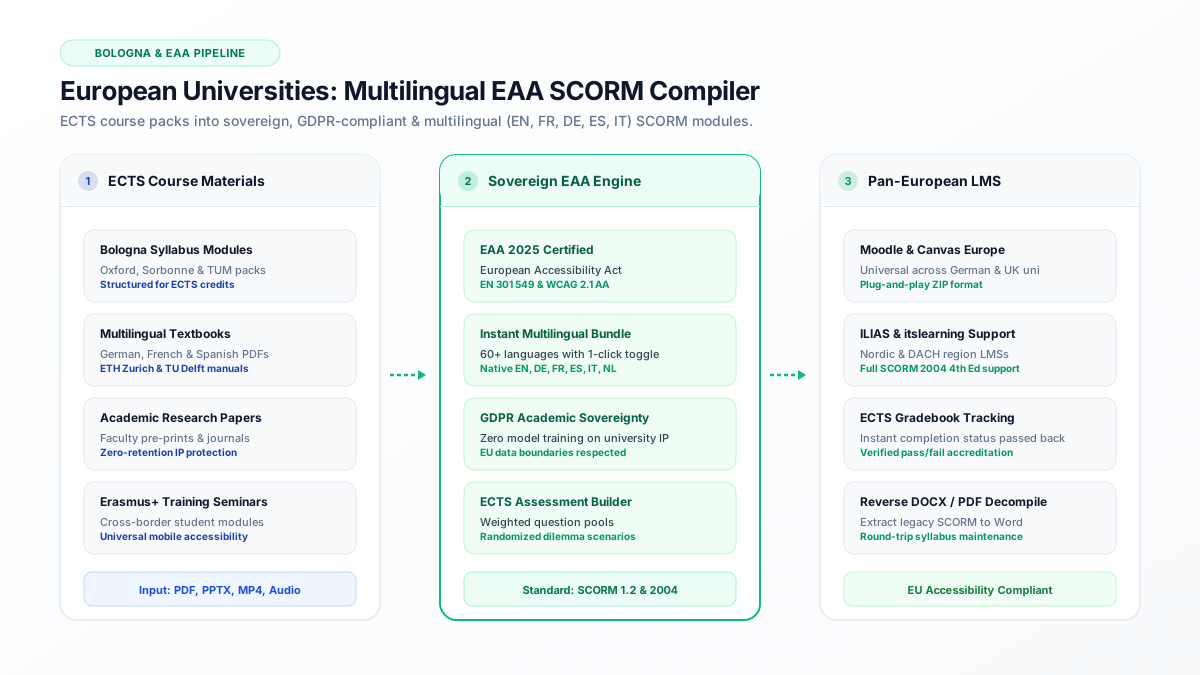
Direct Answer: Full conformance with the European Accessibility Act (EAA 2025) and EN 301 549 digital accessibility standards.
- Full conformance with the European Accessibility Act (EAA 2025) and EN 301 549 digital accessibility standards.
- Modularizes course packs according to Bologna Process ECTS credit criteria.
- Delivers unified 60+ language bundles (EN, DE, FR, ES, IT, NL) in a single SCORM archive for international Erasmus+ programs.
- Strict GDPR academic data sovereignty: faculty lecture notes and unpublished manuscripts are never stored or used to train external models.
The European Accessibility Act (EAA 2025) & Academic LMS Compliance
With the enforcement of the European Accessibility Act (Directive 2019/882) and standard EN 301 549 across EU member states, European universities face strict statutory requirements to make all digital learning materials accessible to students with disabilities. Course readers, slide presentations, and online assessments must be fully navigable via assistive technologies.
DocScorm guarantees that every generated SCORM course satisfies WCAG 2.1 Level AA benchmarks automatically, enabling universities in Germany, France, the Netherlands, and across Europe to achieve instant compliance without hiring external accessibility remediation agencies.
- Pre-tested against EN 301 549 European accessibility criteria.
- Automated semantic markup with zero barrier for visually impaired learners.
- Downloadable compliance certificate for institutional quality assurance boards.
Bologna Process & ECTS Modularization: Structuring Dense Academic Syllabi
The Bologna Process standardizes higher education across 48 countries through the European Credit Transfer and Accumulation System (ECTS). Each ECTS credit typically represents 25 to 30 hours of total student workload, comprising direct lecture time, independent reading, and assessment.
DocScorm automatically chunks dense multi-chapter course readers into modular study blocks corresponding to specific ECTS workload allocations. Students can bookmark their progress, review key concepts at their own pace, and take formative quizzes that certify milestone completion.
Delivering Multilingual Courses Across Cross-Border European Consortia
Under the European Universities Initiative (Erasmus+), university alliances such as CIVIS, Una Europa, and Circle U require seamless cross-border course delivery. However, students across participating campuses speak different native languages.
DocScorm compiles unified multilingual SCORM packages containing up to 60+ language bundles within a single ZIP file. A student in Munich can read the module in German, while their peer in Paris switches to French, and an Erasmus exchange student reviews in English—all tracking back to a single unified Moodle or Canvas gradebook.
Academic Data Sovereignty: Why GDPR Forbids Feeding University IP into Consumer AI
European universities operate under stringent GDPR regulations (Regulation EU 2016/679) and strict academic intellectual property guidelines. Uploading unpublished faculty research, clinical trial methodologies, or exam questions to public consumer AI platforms breaches academic confidentiality and risk forfeiture of patent rights.
DocScorm is engineered with strict sovereign data boundaries: all files are processed in ephemeral memory buffers with immediate discard upon package generation. No academic text is ever logged, retained, or utilized to train external foundational models.
Deploying to Pan-European LMSs: Moodle, Canvas, ILIAS, and itslearning
While Canvas and Moodle dominate the UK and Northern Europe, systems like ILIAS and itslearning are widely deployed across Germany, Scandinavia, and Switzerland. DocScorm generates pure, universal SCORM 1.2 and SCORM 2004 4th Edition packages with dynamic CMI adapters that execute flawlessly across all major European learning platforms.
Connect your instructional workflows directly to DocScorm's course creation tools and validators:
Convert PDFs (Up to 200 Pages), DOCX, PPTX, or MP4 Videos into SCORM in 60s
Open DocScorm Studio or explore the Pro Plan (50 monthly credits + 1-click multi-language bundles + embedded course-source.json round-trip editing).
Frequently Asked Questions
How does DocScorm ensure compliance with the European Accessibility Act (EAA)?
DocScorm compiles courses into standard HTML5 with semantic tags, ARIA attributes, full keyboard navigation support, and verified color contrast exceeding 4.5:1, fulfilling EN 301 549 and WCAG 2.1 AA mandates.
Can students switch between German, French, and English within the same SCORM course?
Yes. With DocScorm’s multi-language compiler, students can toggle between languages directly in the course navigation bar without reloading the LMS page or losing their quiz progress.
Where is data processed and does DocScorm comply with GDPR Article 28?
DocScorm enforces complete data isolation. Customer files are processed ephemerally and never retained or used for model training, fulfilling GDPR data protection standards for European higher education institutions.