DOJ ADA Title II 2026 Mandate: Higher Ed Guide to Accessible Courseware & SCORM
Everything university administrators, legal counsels, and instructional designers need to know about DOJ’s 2026 Title II rule requiring WCAG 2.1 AA across all digital course materials.
Direct Answer: The US Department of Justice 2026 Final Rule mandates WCAG 2.1 Level AA for all public university and community college online coursework.
- The US Department of Justice 2026 Final Rule mandates WCAG 2.1 Level AA for all public university and community college online coursework.
- Unstructured PDF course readers are primary targets for federal civil rights complaints due to missing reading orders and non-tagged data tables.
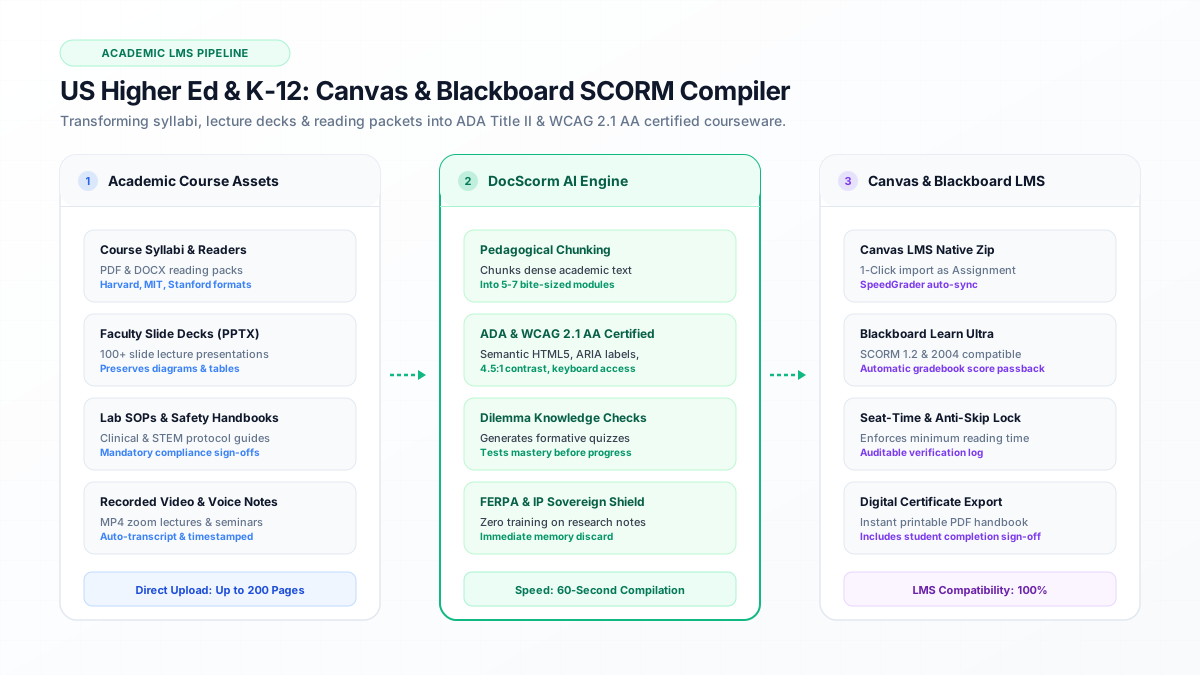
- DocScorm automatically converts static documents into semantic HTML5 with native ARIA landmarks and 4.5:1 contrast ratios.
- Dual output enables accessibility offices to provide both interactive digital modules and high-contrast printable student handbooks.
Direct Answer: DOJ ADA Title II 2026 Requirements for University Courseware
Under the US Department of Justice 2026 final rule for ADA Title II, all public colleges, state universities, and K-12 districts must ensure all online course materials meet WCAG 2.1 Level AA accessibility standards. Unstructured PDFs fail because they lack semantic headings, keyboard tab order, and screen-reader navigable tables.
DocScorm automatically decomposes static course readers into semantic HTML5 with native ARIA landmarks, verified 4.5:1 contrast ratios, and keyboard traps, insulating institutions from legal liability and civil rights audits.
- Effective Date: Mandatory compliance enforced across public educational institutions by early 2026.
- Scope: Applies to all LMS materials, syllabi, lecture slides, supplemental readings, and homework quizzes.
- Standard: WCAG 2.1 Level AA across 50 distinct success criteria.
Why Static PDFs Trigger Federal ADA Injunctions
For over a decade, universities relied on Adobe Acrobat automated PDF tagging to achieve superficial compliance. However, modern assistive technology tests reveal severe deficiencies in scanned course packets:
| Accessibility Dimension | Static PDF Course Reader | DocScorm Semantic HTML5 Module |
|---|---|---|
| Screen Reader Reading Order | Often scrambled across multi-column layouts | Strict semantic DOM hierarchy (H1, H2, P, UL) |
| Keyboard Navigation | Inconsistent tab stops and focus jumping | Logical tabindex with visible focus rings |
| Color Contrast | Fixed image text failing 4.5:1 ratio | Engineered CSS tokens with 7:1+ contrast |
| Screen Zoom & Reflow | Requires horizontal scrolling at 200% zoom | 100% fluid responsive reflow without horizontal scroll |
| Screen Reader Text-to-Speech | Stumbles on ligatures and hyphenations | Clean phonetic markup with pronunciation tags |
Automating Title II Compliance Across Entire Academic Departments
Rather than hiring accessibility remediators at $120 to $180 per document, academic departments use DocScorm to batch compile entire course folders. The platform validates every slide against automated accessibility test suites before generating the final SCORM ZIP package.
Connect your instructional workflows directly to DocScorm's course creation tools and validators:
Convert PDFs (Up to 200 Pages), DOCX, PPTX, or MP4 Videos into SCORM in 60s
Open DocScorm Studio or explore the Pro Plan (50 monthly credits + 1-click multi-language bundles + embedded course-source.json round-trip editing).
Frequently Asked Questions
Does the DOJ ADA Title II rule apply to private colleges?
While Title II directly governs public state universities and community colleges, private institutions receiving federal funding (Pell Grants, research grants) are governed by Title III and Section 504 of the Rehabilitation Act, which federal courts interpret with identical WCAG 2.1 AA standards.
Are historical course archives exempt from the 2026 mandate?
Archived materials that are inactive do not need immediate remediation; however, the moment an archived syllabus or course reading is assigned to an active class section, it must immediately satisfy WCAG 2.1 AA standards.